Cascaded networks for highway ETC lanes, roadside millimeter-wave radar, and incident-detection cameras.
Smart highway construction, including V2X, intelligent ETC lanes, and all-weather incident detection, depends on dense roadside sensors such as millimeter-wave radar, HD video cameras, LiDAR, and weather monitoring devices.
As roadside sensing accuracy improves, each node generates rapidly increasing data volumes. This creates strict requirements for bandwidth, latency consistency, and fiber duct utilization. Traditional multi-core direct fiber or cascaded industrial-switch designs either consume excessive fiber resources or accumulate store-and-forward latency, failing to meet V2X sub-millisecond requirements.
This solution uses Goilips 10G/25G CWDM colored optical modules with roadside passive Mux/Demux. Multiple roadside sensing nodes over several kilometers can be multiplexed at the physical layer into one single-mode fiber, building a low-cost, high-bandwidth, sub-millisecond smart highway sensing access network.
For aggregated backhaul of millimeter-wave radar, panoramic or bullet event-detection cameras, LiDAR, and other dense roadside sensing data.
For reliable low-latency interaction between license-plate recognition, RSU antennas, and rear control rooms at highway toll gantries.
For high-density access of multi-source sensing devices in tunnels, large bridges, and areas with extremely limited fiber duct capacity.
Roadside RSU, radar, and camera nodes connect to access terminals or industrial switches equipped with Goilips CWDM modules at specified wavelengths. Passive roadside CWDM OADM/Mux/Demux devices combine wavelengths into a single-fiber trunk and transport them to the highway MEC room at a service area or toll station.
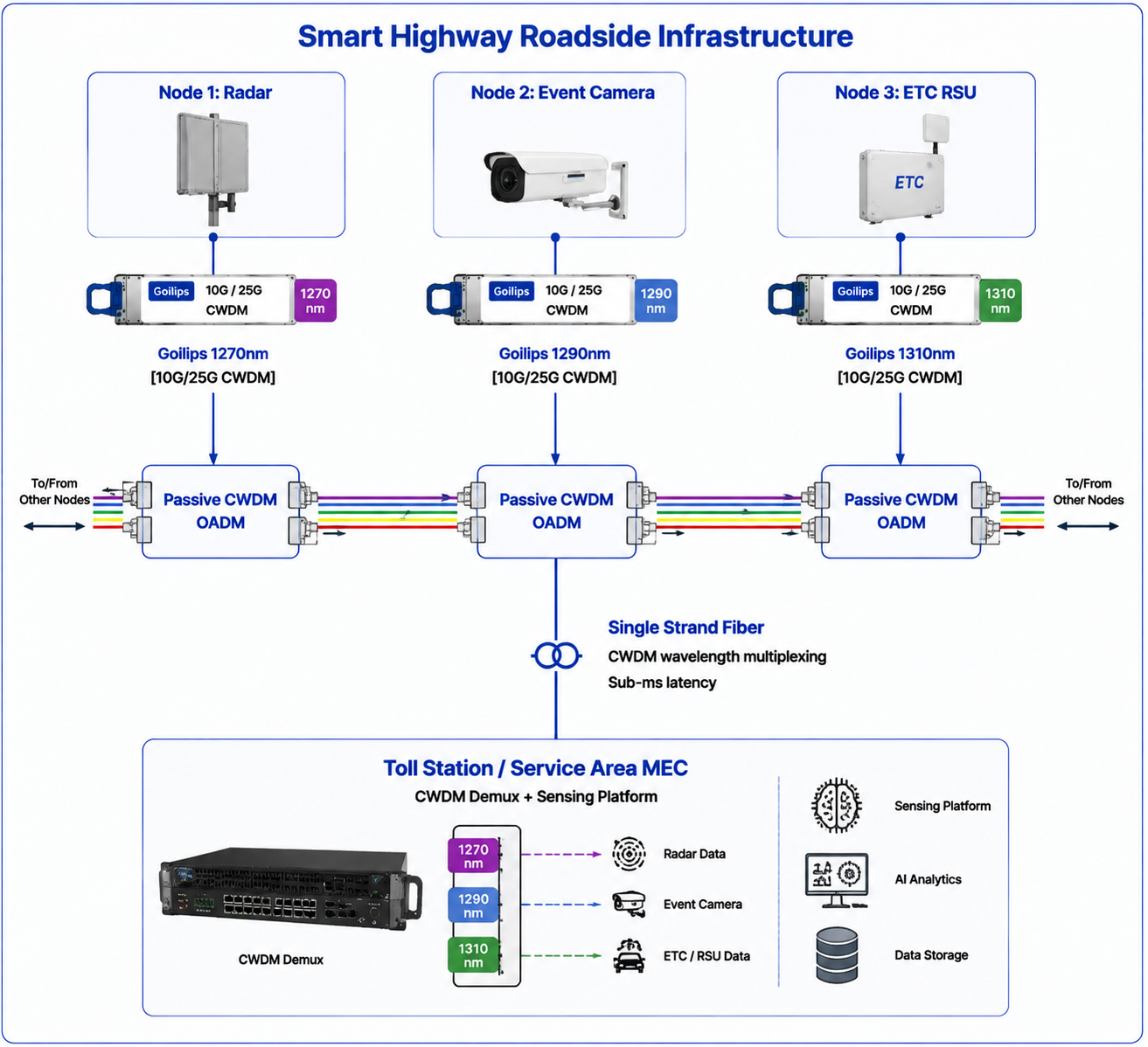
Core Deployment:Goilips 10G CWDM SFP+ 10km/20km using 1270nm - 1610nm 18-wavelength CWDM over single-mode single-fiber infrastructure.
Advantage:Supports 10km - 20km roadside access with high wavelength density and low passive-layer latency.
Core Deployment:Goilips 25G CWDM SFP28 10km/20km using 1270nm - 1370nm front six CWDM wavelengths.
Advantage:Supports high-throughput radar, LiDAR, and V2X sensing nodes over single-mode single-fiber links.
Core Deployment:Uses passive OADM/Mux/Demux devices for wavelength add/drop and physical-layer aggregation.
Advantage:Avoids multi-stage switch store-and-forward processing and removes latency accumulation.
Core Deployment:Supports -40°C to +85°C operation with DDM optical power and temperature monitoring.
Advantage:Fits roadside pole boxes and cabinets exposed to summer sun, winter cold, and outdoor environmental stress.

CWDM carries up to 18 independent 10G/25G wavelengths on one fiber, replacing dozens of fiber cores and reducing trenching and cable deployment cost.
Passive CWDM devices require no power and add no active failure points, reducing outages caused by lightning, rainstorms, or power faults.
New LiDAR or higher-resolution camera channels can be added by inserting Goilips modules on unused CWDM wavelengths without civil works.
Simplify your network deployment and reduce complexity. Connect with our engineers for a solution design tailored to your project.
Expert customer service on call, 5x24 phone support.
For general questions, email us anytime.
Our live agent is ready to chat and help in real time.